Is your organisation ready to scale? What boards should know about organisational health
The biggest lever you have in your business is your people. A strong strategy only delivers when you have the leadership, capability, structure and culture to support it.
But how do boards know whether their organisation has what it takes to deliver on its ambitions?
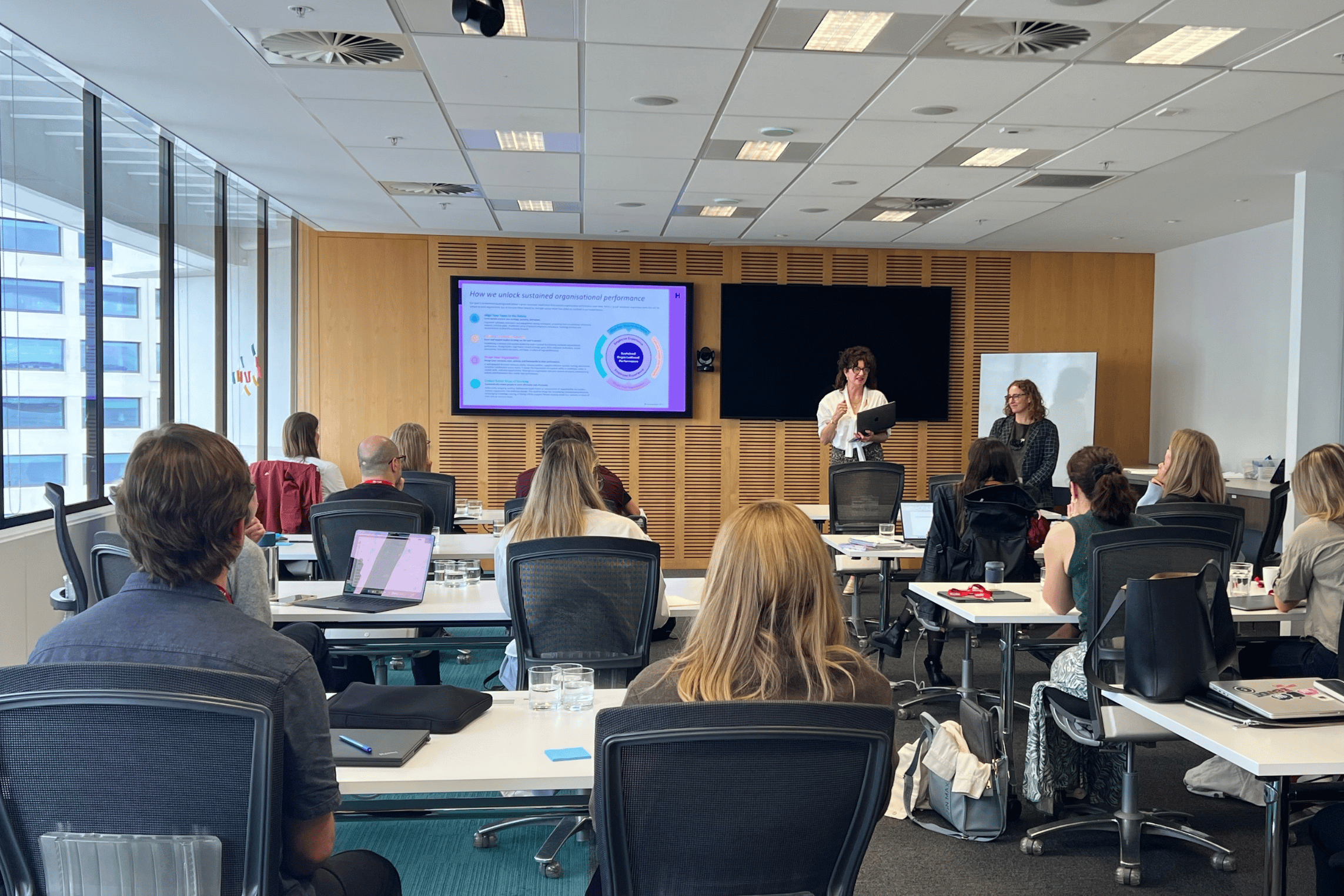
We recently explored this with participants in OnBoard, a programme developing the next generation of start-up directors through governance training and hands-on experience as Board observers.
Our session focused on the challenges facing start-ups and scaling businesses, drawing on Humankind's Organisational Performance model to share practical questions, tools and real-world Board scenarios to help directors understand whether their organisation has what it takes to scale successfully.
Growth changes what an organisation needs
As businesses expand into new markets, introduce products or grow their teams, the demands on the organisation change.
Decisions involve more people, teams become increasingly dependent on one another, and leaders need to achieve results through others. The structures and ways of working that have supported success at the early stages can gradually become constraints. The risk is that the business grows faster than the organisation’s ability to support it.
For boards, the challenge is recognising where organisational capability may be falling behind the strategy, ideally before it starts affecting performance.
At Humankind, our Organisational Performance model focuses on four interconnected areas that enable sustained performance:
- Align Your Team to the Future: Unite people around strategy, purpose and values.
- Cultivate Leadership Strength: Grow and support leaders to bring out the best in people.
- Shape Your Organisation: Design structures, roles and frameworks that enable performance.
- Embed Better Ways of Working: Create practices that help people work effectively together.
At the centre is employee experience. When people have the clarity, support and conditions to do their best work, organisations are better positioned to perform.
These four areas provide a good lens for boards to understand organisational health and where management may need support or challenge.
Four questions boards should be asking as businesses scale
1. Strategic alignment: Are our people moving in the same direction?
As businesses grow, keeping everyone aligned on the strategy takes more deliberate effort. With new teams, leaders and locations, priorities can become less clear and people can end up working towards different goals.
A clear strategy needs to translate into shared priorities across the organisation, so people understand what matters most and how their work contributes to success.
What should Boards look for? Whether people understand the strategy, how team goals connect to it and where competing priorities may be getting in the way of delivery.
Ask: How do we know our people understand where we're going, why it matters and how their work contributes?
2. Leadership: Are we building capability ahead of growth?
As businesses grow, what they need from their leaders changes. CEOs need to spend more time setting direction, developing their leadership teams and empowering others to make decisions.
Across the organisation, people often move into leadership roles because they're great at what they do, but leading others requires a different set of skills.
Boards have an important role in supporting the CEO's development and ensuring the organisation is building the leadership capability it needs for the future.
One of the questions we asked during OnBoard was:
If the CEO disappeared tomorrow, what would stop working?
The answer can highlight where the organisation is overly reliant on particular individuals and where leadership development or succession planning may need attention.
What should Boards look for? Gaps in leadership capability, succession coverage for critical roles, decision-making that's overly dependent on the CEO or a small number of people, and evidence that leaders are being developed for what's ahead.
Ask: What leadership capability will our strategy require, and how confident are we that we're building it?
3. Organisation design: Are we set up to deliver?
As businesses grow, teams become more specialised, responsibilities evolve and the way work gets done needs to change too.
We often see organisations trying to address performance challenges by focusing on individuals, when the real issue lies in how the organisation is structured and how people work together.
Even great people can struggle to perform when roles are unclear, decisions take too long or teams are working towards competing priorities.
For Boards, the question is whether the organisation is set up to deliver its strategy, with the right structure, capability and accountability in place.
What should Boards look for? Unclear accountabilities or decision rights, duplicated effort, unnecessary management layers, capability gaps and bottlenecks that are slowing delivery.
Ask: Is our organisation designed for where we're going, or where we've been?
4. Culture: Is our culture supporting the business we're becoming?
A strong culture helps people stay connected, work well together and make good decisions as a business grows. But scaling it takes deliberate effort, particularly as employees increasingly experience the organisation through their managers and everyday interactions.
For boards, understanding culture means looking beyond engagement scores to the behaviours that are rewarded or tolerated, how leaders hold people accountable and whether employees feel comfortable speaking up.
Take a high performer whose behaviour consistently undermines others - aAre they held to the same expectations? What message does that send about what the organisation really values?
These everyday decisions shape culture and influence how effectively people work together and perform.
What should Boards look for? Patterns in employee feedback, leadership behaviour, regrettable turnover, speak-up or conduct issues, and differences in experience across teams or locations.
Ask: Does our current culture enable or constrain delivery of our strategy?
From people metrics to meaningful organisational insight
During our OnBoard session, we asked participants:
If you had only 10 minutes to understand whether an organisation was healthy, what would you want to know?
A Board pack can contain plenty of people data, but the real value comes from understanding what it tells us about performance and where risks may be emerging.
Take employee turnover. Knowing the overall percentage is one thing. Understanding that you're losing high-performing people in business-critical roles tells you much more about the potential impact on your strategy.
What should Boards be looking for?
The information a Board needs will depend on the organisation's strategy, stage of growth and material risks. Here are some examples of areas to explore and evidence that can help:
Area: Strategic alignment
Possible evidence and indicators: Understanding of strategic priorities, alignment of team objectives
Area: Leadership and capability
Possible evidence and indicators: CEO performance assessments, succession coverage, critical capability gaps
Area: Organisation design
Possible evidence and indicators: Decision-making speed, spans and layers, delays in delivering strategic priorities
Area: Culture and employee experience
Possible evidence and indicators: Engagement trends, regrettable turnover, employee feedback, employment relations cases
Area: Health and safety
Possible evidence and indicators: Critical risk reviews, control effectiveness, incident trends, psychosocial risk indicators
These are examples of information Boards might seek, rather than a standard set of dashboard metrics. Some are measurable indicators, while others require feedback, discussion or further investigation.
The important thing is understanding what the evidence is telling you, how it relates to the strategy and what management is doing in response.
Health and safety is a governance responsibility
One area where this need for evidence is particularly important is health and safety. Under New Zealand's Health and Safety at Work Act, directors who are officers have personal due diligence duties to ensure their organisation is meeting its obligations.
This requires Boards to take an active interest in health and safety, understand the organisation's material risks, ensure appropriate systems, resources and controls are in place, and seek evidence that these are working effectively. This includes having sufficient visibility of psychosocial risks, such as harmful workloads, bullying and harassment, and assurance that these are being appropriately identified and managed.
People risk is business risk
The message we left the OnBoard cohort with was simple: leadership, capability, culture and organisation design are fundamental to business performance.
For directors, good governance means asking questions that reveal how well the organisation is positioned to execute its strategy, while supporting and challenging management to address emerging risks.
So perhaps the question for Boards is bigger than "Are we performing today?"
It's "Are we building the organisation we need to succeed tomorrow?"
At Humankind, we work alongside boards, CEOs and leadership teams to strengthen organisational performance, from CEO and leadership effectiveness through to succession planning, organisation design and strategic People & Culture support.